
Greno Industries delivers advanced exotic metals machining services for high-consequence aerospace, defense, subsea energy, nuclear, and turbomachinery applications. Operating under AS9100:2016 and ISO 9001:2015 certified quality management systems, our machine shop specializes in turning, milling, and wire EDM of difficult-to-machine superalloys that cause conventional cutting tools to fail.
Where standard machine shops struggle with work hardening, thermal distortion, chatter, and rapid tool degradation, Greno applies proven cutting physics. By pairing ultra-rigid CNC machine platforms with 1,000+ PSI high-pressure coolant systems, customized tool geometries, and dynamic trochoidal CAM toolpaths, we hold tolerances as tight as ±0.0001 inches (±0.0025 mm) across the world’s toughest alloys.
Exotic superalloys and specialized materials possess physical properties that run counter to standard chip-formation mechanics:
Extreme Work-Hardening Rates: Austenitic nickel and cobalt matrices harden instantaneously ahead of the cutting edge if the tool rubs or dwells. Greno programs uninterrupted, positive-shear chip loads that continuously cut beneath the work-hardened shear zone.
Low Thermal Conductivity: Unlike aluminum or carbon steel, exotic alloys transfer minimal heat into the chip. Heat concentrates directly at the tool-workpiece interface. We employ high-pressure through-spindle coolant (HPC) to blast coolant directly into the cut zone, quenching heat before thermal cracking occurs.
Abrasive Carbide Microstructures: Microscopic titanium and niobium carbides inside superalloys act as cutting abrasives against tooling. We match specialized PVD-coated micrograin carbides, ceramic inserts, and polycrystalline cubic boron nitride (PCBN) to specific alloy chemistries.
Titanium pairs steel-like tensile strength with roughly 45% less weight and broad galvanic corrosion resistance. Its low modulus of elasticity makes it prone to spring-back and chatter during thin-wall milling. Greno utilizes high-rigidity hydraulic toolholders and tailored feed rates to mitigate part deflection in airframe brackets, medical trial implants, and marine pressure housings.
The standard of hot-gas-path turbomachinery and downhole sour-gas drilling. Inconel maintains high yield and tensile strength at temperatures up to 1,800°F (982°C). Its extreme toughness and tendency to develop built-up edge (BUE) demand aggressive, continuous feed rates, heavy-duty spindle torque, and rigid fixturing to eliminate micro-vibrations.
Formulated for hostile chemical, flue gas, and sour crude environments, Hastelloy provides superior resistance to pitting, crevice corrosion, and stress corrosion cracking. Machining Hastelloy produces tough, continuous stringy chips and rapid cutting-edge notch wear. Greno applies optimized chip-breaker geometry and controlled surface footage to produce clean, burr-free sealing surfaces.
Monel is a nickel-copper alloy that resists sea water, hydrofluoric acid, sulfuric acid, and alkaline solutions. Monel K-500 adds precipitation-hardening properties that increase hardness to 35+ HRC. Because Monel is gummy and work-hardens rapidly, we run sharp, high-positive rake angles, rigid machine setups, and specialized sulfurized or synthetic coolants to ensure clean finishes on submarine shafts, valve stems, and impellers.
A nickel-iron-chromium alloy family engineered for structural stability, oxidation resistance, and carburization resistance in thermal processing and petrochemical reactors. Incoloy combines the high-temperature strength of nickel with the economy of iron, but it demands careful thermal management during turning and drilling to prevent thermal shock and tool micro-chipping.
Invar (36% nickel, 64% iron) is recognized for its uniquely near-zero coefficient of thermal expansion (CTE) between cryogenic temperatures and 500°F. Widely used in aerospace composite layup tooling, laser optical benches, and satellite wave-guides. Invar is ductile, gummy, and transfers heat poorly, requiring specialized speeds and tool edge preparation to avoid tearing the surface finish.
René alloys are precipitation-hardenable nickel-base superalloys engineered for exceptional strength in jet engine and rocket motor components operating above 1,600°F. Machining René 41 represents one of the steepest challenges in subtractive manufacturing due to its extreme shear resistance and abrasive gamma-prime phase. Greno pairs rigid CNC centers with ceramic and sub-micron carbide tooling to cut intricate airfoil and shroud geometries.
| Alloy Family | Typical Grades Machined | Machinability Rating (AISI 1212 = 100%) | Primary Machining Challenge | Primary Applications |
|---|---|---|---|---|
| Titanium Alloys | Ti-6Al-4V, Ti-6Al-4V ELI, Grade 2 | ~20% – 30% | Low thermal conductivity, elasticity / part spring-back | Aircraft structural fittings, space brackets, medical instruments |
| Inconel Superalloys | Inconel 718, Inconel 625 | ~12% – 18% | Rapid work hardening, high abrasive carbide content | Turbine buckets, combustion swirlers, downhole HPHT valves |
| Hastelloy Alloys | Hastelloy C-276, Hastelloy X | ~15% – 20% | High strain hardening, gummy chip formation | Petrochemical reactors, marine scrubbers, acid valves |
| Monel Alloys | Monel 400, Monel K-500 | ~20% – 25% | Gumminess, severe tool notching, stringy chips | Submarine propulsion shafts, chemical pump impellers |
| Incoloy Alloys | Incoloy 800, Incoloy 825 | ~25% – 35% | Heat localization, work hardening in deep holes | Heat treating retorts, sour gas tubing, flare stacks |
| Invar Alloys | Invar 36 | ~30% – 35% | Poor surface finish generation, ductile smearing | Satellite optical housings, composite layup molds |
| René Alloys | René 41, René 80 | ~8% – 12% | Severe shear strength, extreme abrasive tool wear | Rocket propulsion nozzles, turbine rotor tie bolts |
5-Axis Simultaneous CNC Milling: Single-setup machining of complex contoured geometries, blisks, and thin-walled housings, eliminating compound error caused by multiple clampings.
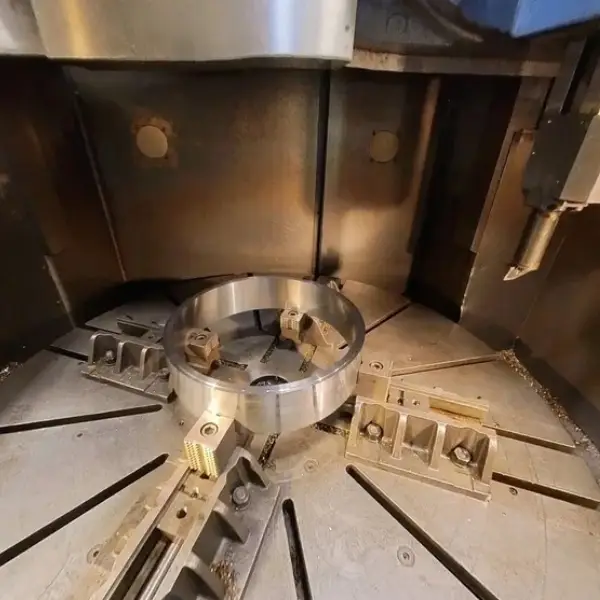
Heavy CNC Turning & Boring: High-torque horizontal and vertical turning lathes (VTL) capable of turning shafts, sleeves, and rings up to 60+ inches in length.
Wire & Sinker EDM: Non-contact electrical discharge machining that eliminates cutting tool pressure, ideal for intricate internal splines, micro-holes, and delicate flexures in pre-hardened superalloys.
Through-Tool High-Pressure Coolant (1,000+ PSI): Direct delivery of coolant to the shear zone for instantaneous chip clearing and thermal dissipation.
Greno enforces strict quality gates to guarantee that every exotic metal component meets its critical design specifications:
AS9100 Rev D & ISO 9001:2015: Certified quality management with standardized process validation.
100% Raw Material Traceability: Verifiable Mill Test Reports (MTR) detailing chemical analysis, heat treatment history, and DFARS compliance.
Automated CMM Dimensional Metrology: Zeiss coordinate measuring machines operating within climate-controlled inspection rooms for full GD&T verification.
Certified Secondary Processes: Turnkey management of Nadcap-accredited heat treating, solution annealing, passivation, and Non-Destructive Testing (NDT) including FPI, MPI, and ultrasonic inspection.
Exotic metals refer to specialized alloys not predominantly composed of carbon steel or aluminum. They include nickel-base superalloys, cobalt alloys, titanium, and refractory alloys engineered for operating environments characterized by extreme heat, high mechanical stress, corrosive chemistry, or severe radiation.
Inconel and René alloys cost significantly more in raw material form, cut at substantially lower surface speeds (SFM) to manage heat, and accelerate cutting tool wear. A single exotic alloy part may require multiple carbide or ceramic inserts that would cut dozens of standard steel parts.
Yes. We routinely machine pre-hardened superalloys (such as Inconel 718 at 40–45 HRC or Monel K-500 aged to 35 HRC) using high-rigidity CNC tooling setups, specialized ceramic/PCBN cutting tools, and wire EDM.
Submit your 3D CAD models (STEP, Parasolid, IGES), 2D drawings with GD&T callouts, specific alloy grade specifications (AMS, ASTM, or proprietary specs), and target quantities via our secure RFQ portal. Our engineering team typically returns formal DFM feedback and quotations within 24 to 48 hours.
Submit your CAD models and 2D prints for engineering review and rapid pricing.
Email: RFQ@grenoindustries.com
Direct Phone: (518) 393-4195
Location: 2820 Amsterdan Rd, Scotia, NY 12302
Upload Files: Request a Quote Online (STEP, IGES, DXF, and PDF drawings)